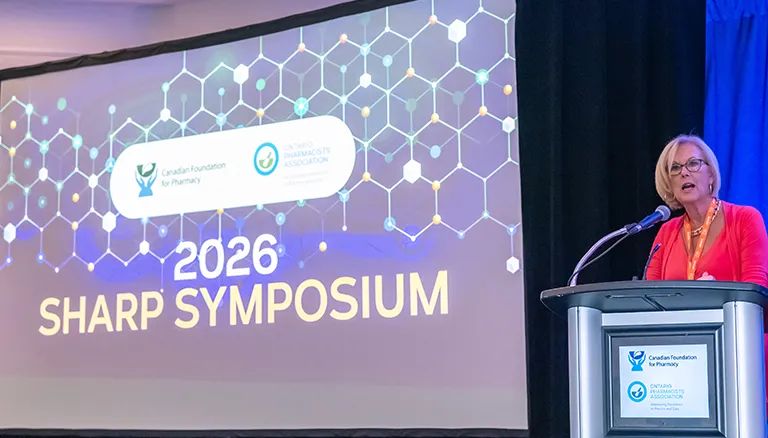
Bringing pharmacy research into everyday practice—and using that evidence to help shape healthcare policy—was the focus of the 2026 SHARP Symposium, held September 30 in downtown Toronto.
Co-hosted by the Canadian Foundation for Pharmacy (CFP) and the Ontario Pharmacists Association (OPA), the annual Strengthening Health with Research in Pharmacy (SHARP) Symposium brought together more than 100 researchers, academics, policymakers and pharmacy professionals under the theme, Building an Equitable, Integrated Health System.
This year’s program explored two interconnected priorities: breaking down silos to support more collaborative healthcare and ensuring patients are not left behind as healthcare systems and pharmacy services evolve.
CFP Executive Director Linda Prytula highlighted the importance of research reaching beyond academic settings to inform—and be informed by—the daily work of practising pharmacists and healthcare teams. That message was reflected throughout the day’s presentations, which explored both the opportunities for pharmacy to contribute more to patient care and the challenges of making that happen.
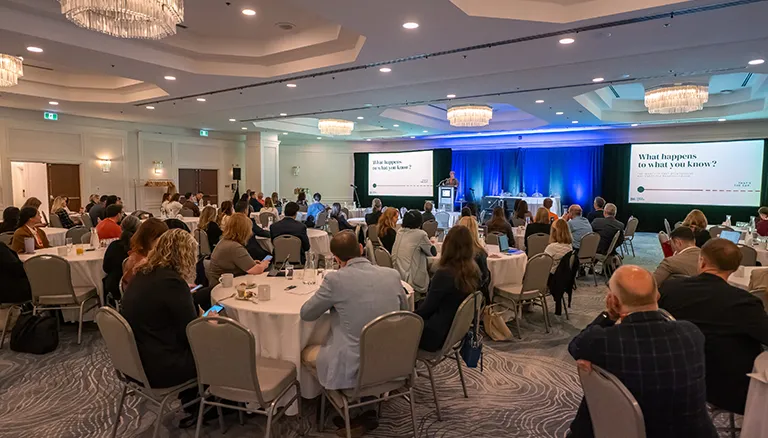
“Our hope is that you leave with new ideas and a renewed sense of what is possible when research, practice and advocacy come together,” said Prytula during her closing remarks.
All 30 abstracts from the oral and poster presentations at the SHARP Symposium will be published in CFP’s upcoming Changing Face of Pharmacy report, available later this year.
Connecting patients to care
Opening plenary speaker Michelle Nelson from the University of Ottawa’s School of Epidemiology and Public Health challenged attendees to rethink the role community pharmacies can play in connecting people with healthcare services and community resources.
Nelson described how pharmacies’ established relationships with patients and their knowledge of local communities could be used to strengthen connections across the health system. She encouraged pharmacists to consider how the information they gather through everyday patient interactions could be shared, documented and used to improve care beyond the pharmacy itself.
Another presentation demonstrated how community pharmacies could help address gaps in primary care access. Researchers Meriam Salih, Mohamed Elsabakhawi and Nabeel Effendi described an initiative at three community pharmacy sites in Mississauga that identified unattached patients (i.e., without a family physician) and offered to connect them with primary care services.
During the first two months, 62 unattached patients were approached and 56% accepted the offers of assistance to connect them with a family physician. This project illustrated how community pharmacies could serve as another entry point into the healthcare system, helping patients navigate services.
Making expanded scope work in practice
Making better use of pharmacy teams was another important theme. Danielle Paes, Yvon Picard and Jeff Mehltretter presented preliminary findings from Unlocking Millions of Clinician Hours: A Time-and-Motion Study of Community Pharmacy Practice, supported by CFP’s Innovation Fund.
The research so far has involved 174 hours of observation in 23 community pharmacies across Ontario and Saskatchewan. Pharmacists spent approximately 21% of their time on activities requiring a pharmacist’s licence, while substantial portions of their working hours were devoted to tasks that could potentially be delegated to pharmacy assistants or registered pharmacy technicians.
The findings raised questions about how pharmacy workflow and staffing could be redesigned to give pharmacists more time for clinical services. Researchers also found that pharmacists tended to overestimate how much time they spent on activities requiring their licence, suggesting that opportunities for delegation may not always be recognized. The research team plans to expand the study to better understand these patterns.
Other presentations explored the practical challenges of expanding pharmacy services, including the integration of injection-trained pharmacy technicians into vaccination workflows and the impact of workplace pressures on pharmacy professionals’ ability to deliver care. Together, the findings highlighted the importance of ensuring that expanded scope is supported by appropriate staffing, workflows and working conditions
scope is supported by appropriate staffing, workflows and working conditions.
Reaching those who need services most
Health equity was a central focus of a plenary presentation by Wasem Alsabbagh, Associate Professor at the University of Waterloo’s School of Pharmacy.
He discussed research examining disparities in opioid-related care, minor ailments services and vaccination. He also raised questions about whether the populations most in need are benefiting from expanded pharmacy services and how research can identify gaps that might otherwise be overlooked.
Alsabbagh emphasized the importance of understanding patients’ social circumstances and using evidence to inform policies that better support disadvantaged communities.
Another presentation, by Yasmin Aboelzahab, examined how a virtual pharmacy-based orientation module could help newcomer international students navigate Canada’s healthcare system. Drawing on feedback from four focus groups, the research identified opportunities for a user-friendly, interactive resource that could raise awareness of pharmacy services, particularly in campus settings. The findings also highlighted the importance of collaboration with universities and other community pharmacies to support students who may be unfamiliar with accessing healthcare in Canada.
The challenge of translating evidence into action resurfaced during a panel discussion featuring pharmacists Kristen Watt, Nardine Nakhla and Emily Black. Panelists emphasized that expanding pharmacists’ scope of practice is only one part of improving healthcare. Equally important is understanding patient outcomes, how services are implemented and what happens after patients are referred to other providers
“We need to look at [expanded scope] not as just a professional win but as a gain for patients,” said Watt, emphasizing the importance of demonstrating patient outcomes when advocating for change.
Nakhla also encouraged researchers to look beyond service uptake and examine the full patient journey, including whether referrals lead to appropriate follow-up care. Black stressed the value of involving other healthcare professionals, patients and the public in research to better understand how services work in practice.